Xylolabs Knowledge Base¶
Indexed reference for the Xylolabs IoT audio and sensor monitoring platform. XAP and XMBP are patent-pending proprietary technologies of Xylolabs Inc.
Core Protocols (Patent Pending)¶
These two protocols form the foundation of the Xylolabs data pipeline. All device firmware, SDK code, and server ingest logic is built around them.
XAP — Xylolabs Audio Protocol¶
XAP is Xylolabs' proprietary MDCT-based spectral audio codec for real-time multi-channel audio compression on resource-constrained IoT and industrial monitoring hardware. Codec ID 0x03 in XMBP.
| Property | Value |
|---|---|
| Transform | MDCT |
| Sample rates | 8, 16, 24, 32, 48, 96 kHz |
| Channels | 1–4 |
| Frame durations | 7.5 ms, 10 ms |
| Compression ratio | 8:1–10:1 |
| Bitrate range | 16–320 kbps per channel |
| CPU requirement | ~10 MIPS/channel (with DSP) |
| RAM per channel | ~8 KB encoder state |
- XAP Specification — Complete protocol spec: MDCT signal flow, encoder architecture, frame wire format, configuration, platform compatibility matrix, SDK integration, IMA-ADPCM comparison
- XAP Specification (한국어)
XMBP — Xylolabs Metadata Binary Protocol¶
XMBP is the compact binary framing protocol for IoT sensor and motor telemetry. It is the on-wire format between all Xylolabs-SDK-equipped devices and the ingest server. Magic bytes: 0x58 0x4D 0x42 0x50 ("XMBP").
| Property | Value |
|---|---|
| Byte order | Big-endian (network order) |
| Timestamps | u64 microseconds |
| Min batch size | 10 bytes (no device ID, no streams) |
| Allocation | Zero — writes directly into caller-supplied buffer |
| Storage format | XMCH (on-server) |
- XMBP Specification — Wire format, batch envelope, stream block layout, sample layout, value type registry, audio codec identifiers, encoding/decoding API, feature flags, transport, XMCH storage format, wire format examples
- XMBP Specification (한국어)
Codec Analysis & Performance¶
Analysis and benchmark data for XAP and all evaluated competing codecs across MCU targets.
- Codec Analysis — 16-codec comparison table, MCU feasibility matrix, LTE-M1 bandwidth budget analysis, XAP design rationale
- Codec Analysis (한국어)
- Performance Evaluation — Benchmark results: encode time per frame, channel scaling, multi-channel CPU budgets, cosine table threshold observation (32 kHz→48 kHz discontinuity), server concurrency benchmarks
- Performance Evaluation (한국어)
- Performance Profile — DSP acceleration matrix per platform, MIPS analysis, ARMv8-M / Xtensa SIMD instruction breakdown, per-platform XAP and ADPCM speedup percentages
- Performance Profile (한국어)
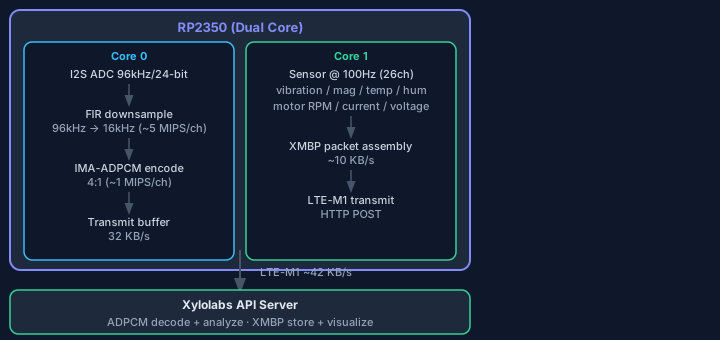
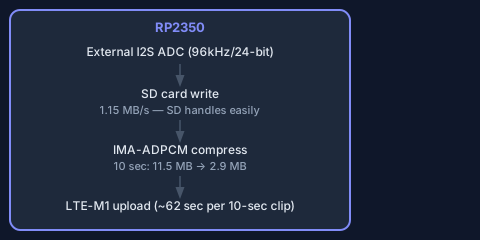
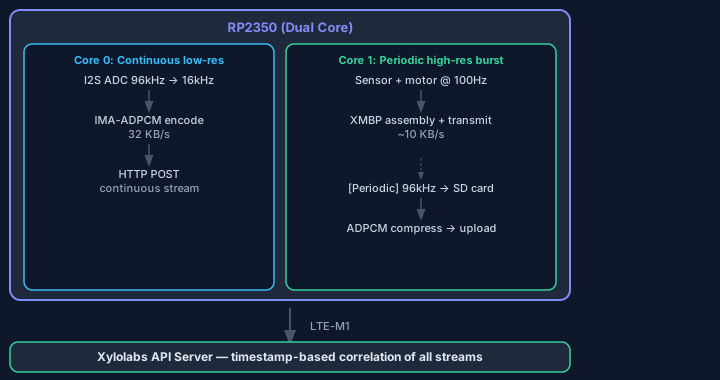
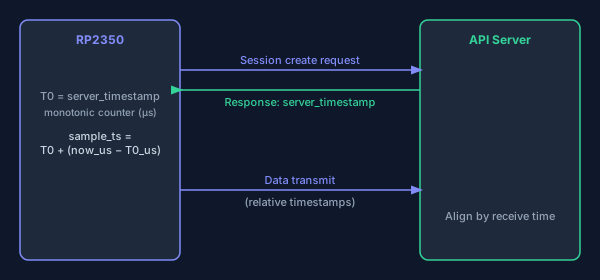
- RP2350 Feasibility Study — 4ch @ 96 kHz XAP feasibility on RP2350: input data specification, resource analysis, CPU budget breakdown, memory layout, LTE-M1 bandwidth model, three deployment options (A/B/C) with trade-off matrix
- RP2350 Feasibility Study (한국어)
Architecture Diagrams¶
Visual references located in diagrams/:
| Diagram | File |
|---|---|
| System architecture overview | diagrams/architecture.svg |
| Ingest pipeline | diagrams/ingest-pipeline.svg |
| Codec comparison chart | diagrams/codec-comparison.svg |
| SDK platform map | diagrams/sdk-platforms.svg |
| Feasibility option A | diagrams/feasibility-option-a.svg |
| Feasibility option B | diagrams/feasibility-option-b.svg |
| Feasibility option C | diagrams/feasibility-option-c.svg |
| Time sync diagram | diagrams/feasibility-time-sync.svg |
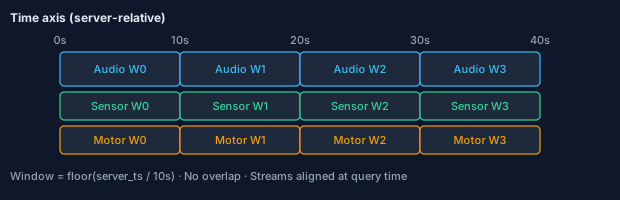
| Window alignment diagram | diagrams/feasibility-window-align.svg |
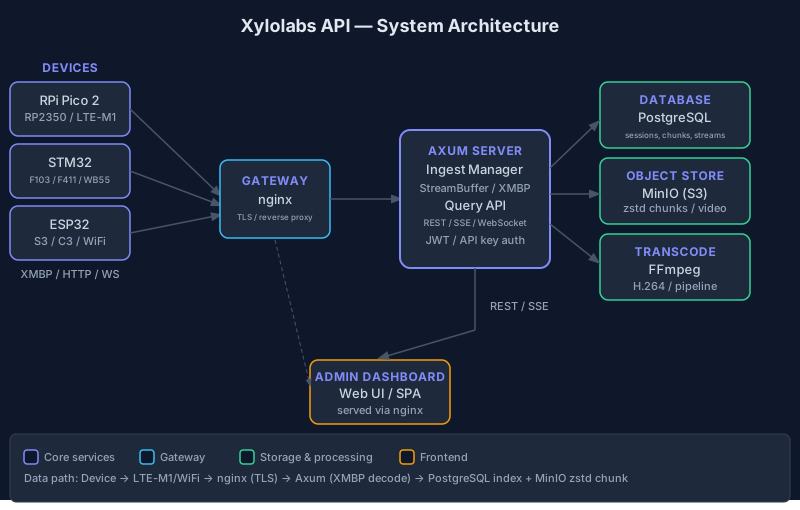
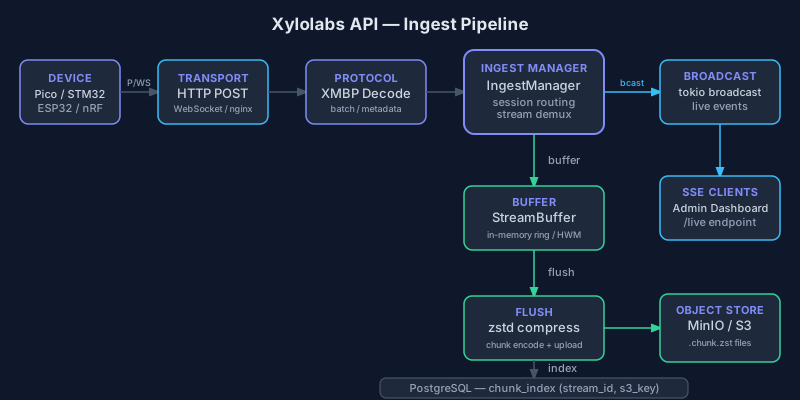
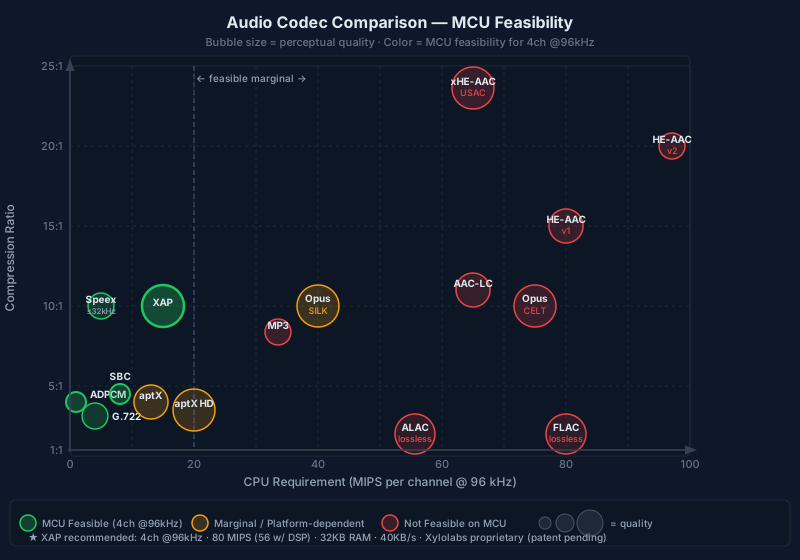
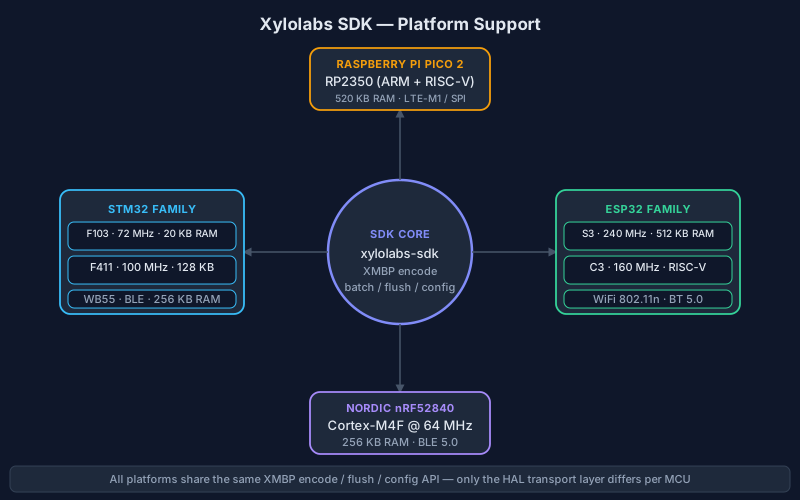
Platform Guides¶
Per-MCU integration guides covering hardware setup, pin assignments, codec capability, and SDK wiring.
RP2350 / Pico 2 W (Primary Target)¶
The primary reference target. Dual Cortex-M33 @ 150 MHz, 520 KB SRAM, PIO-based I2S, CYW43 WiFi/BT, ARMv8-M DSP extensions. Requires external I2S ADC for 96 kHz/24-bit audio.
- RP2350 / Pico 2 W Platform Guide — Specifications, I2S ADC wiring, LTE-M1 modem wiring, pin assignments, SDK integration, codec capability (4ch XAP @ 96 kHz)
- RP2350 / Pico 2 W Platform Guide (한국어)
ESP32-S3 / ESP32-C3¶
Native WiFi — no external LTE modem required. ESP32-S3 supports 4ch XAP @ 96 kHz via 128-bit Xtensa SIMD. ESP32-C3 (RISC-V) is a sensor-only node.
- ESP32 Platform Guide — Supported targets table, I2S MEMS microphone wiring, WiFi native stack notes, codec capability matrix
- ESP32 Platform Guide (한국어)
STM32 (F103, F411, WB55, WBA55)¶
Cortex-M3/M4F/M33 targets. F411, WB55, and WBA55 support XAP (FPU + DSP). WB55 adds BLE with 4ch ADC at 48 kHz; WBA55 at 96 kHz. F103 is sensor-only (no FPU).
- STM32 Platform Guide — Supported targets table (F103 / F411 / WB55 / WBA55), I2S ADC wiring, internal ADC for BLE targets, HAL-based CubeMX-compatible examples, codec capability per variant
- STM32 Platform Guide (한국어)
nRF52840 / nRF9160¶
Nordic Cortex-M4F / Cortex-M33 targets. nRF52840 transports via BLE 5.0; nRF9160 via LTE-M / NB-IoT.
- nRF Platform Guide — Supported targets table, SPI sensor wiring (LIS2DH12), Zephyr RTOS integration, dual transport (BLE GATT / LTE modem) architecture
- nRF Platform Guide (한국어)
RP2040 / Pico (ADPCM-only)¶
Dual Cortex-M0+ @ 133 MHz, 264 KB SRAM. No FPU or DSP — XAP is not feasible. ADPCM only. Cost-effective sensor node.
- RP2040 / Pico Platform Guide — Specifications, key differences from RP2350, ADPCM-only codec limitation, sensor node use case
- RP2040 / Pico Platform Guide (한국어)
Hardware¶
Reference hardware documentation for the Xylolabs RP2350 full sensor node.
- Hardware BOM — Complete bill of materials: MCU (RP2350), audio ADC (PCM1860QDBTRQ1), microphones (WM-61A), environment sensor (SEN0385/CHT832X), accelerometer (ADXL345), LTE modem (BG770A), passives, connectors, purchase links
- Hardware BOM (한국어)
Firmware & OTA¶
- Firmware releases are uploaded to S3 and tracked in the
firmware_releasestable - Deployments target specific devices via the
firmware_deploymentstable with status tracking (pending → downloading → verified → applied) - Devices poll
/api/v1/ota/checkwith their hardware_target to discover updates - Progress is reported back via
/api/v1/ota/deployments/{id}/progress - Admin manages releases and deployments via the Firmware page in the dashboard
Server Features¶
XAP Server-Side Decoder¶
The xylolabs-transcode crate includes a full XAP decoder (xap_decode.rs) that reconstructs PCM from XAP-encoded audio. The transcode pipeline automatically detects .xap uploads and decodes them to WAV before FFmpeg transcoding.
- Inverse MDCT transform:
x[n] = (2/N) * Σ X[k] * cos(π/N * (n+0.5+N/4) * (k+0.5)) - Adaptive dequantization:
coeff = quantized_i8 * step_size - Supports all XAP sample rates (8–96 kHz), 1–4 channels
- Sample rate inferred from frame header
frame_samplesfield
Transcode Queue & Stale Job Reaper¶
Transcoding uses a Postgres-backed job queue with FOR UPDATE SKIP LOCKED for atomic claiming. The worker includes:
- Bounded concurrency via
Semaphore(configurable, 1–32) - Event-driven via
pg_notify('transcode_queue')with 10s polling fallback - Stale job reaper: on startup and every 60s, requeues jobs stuck in
'running'pastTRANSCODE_STALE_TIMEOUT_SECS(default 7200 = 2 hours) - Retry with backoff: failed jobs auto-requeue if under
max_attempts
Ingest Session Modes¶
Sessions operate in one of two modes, configured at creation time:
| Mode | Timeout | Use Case |
|---|---|---|
continuous (default) |
session_timeout_secs (5 min) |
Nonstop streaming (vibration monitors, audio) |
sampling |
max(sampling_timeout_secs, interval×3) (1h+) |
Periodic measurement with idle gaps (battery sensors) |
Sampling-mode sessions carry additional fields:
- sampling_interval_secs: expected seconds between measurement starts (e.g., 300 = 5 min)
- sampling_duration_secs: expected seconds per measurement burst (e.g., 10)
The IngestManager uses per-session timeout instead of a global value. This prevents session explosion for devices that sleep between measurement cycles. The frontend detects gaps in time-series data and breaks chart lines at measurement boundaries.
- Sampling Mode Plan — Implementation plan and design rationale
Metadata Stream Visualization¶
The admin dashboard (admin.api.xylolabs.com) includes a metadata visualization frontend:
- Uploads list (
/metadata): paginated table with device filter, status filter, mode filter, stream counts, sample totals, data sizes - Session detail (
/metadata/:id): per-stream time-series charts (RechartsLineChart), time range selector, sampling info panel, gap-aware rendering for sampling-mode sessions, non-numeric table fallback - Audio waveform (
/uploads/:id): wavesurfer.js interactive waveform player with play/pause and time scrubbing - Device fleet (
/): dashboard with device health status bar, active sessions panel, recent uploads panel
API Reference¶
REST API documentation for the Xylolabs server.
- API Documentation (English) — Full REST API reference: authentication, facilities, users, API keys, devices, audio upload, audio streaming, transcode jobs, tags, metadata ingest, metadata query, system configuration, dashboard stats, health, XMBP protocol reference, RBAC, error responses, data models, pagination, example workflows
- API Documentation (한국어)
SDK — Rust Crates¶
The Rust SDK is the recommended path for all new firmware development. All crates are no_std-compatible.
Core SDK¶
crates/xylolabs-sdk/— Main SDK crate.XylolabsClient<P, AUDIO_RING, XMBP_BUF>state machine,SessionManager,HttpTransport,RingBuffer, XAP codec, ADPCM codec,Platformtrait abstraction. No heap allocation.- xylolabs-sdk (한국어)
crates/xylolabs-protocol/—no_stdXMBP wire format implementation shared between device firmware and server. Single source of truth for XMBP encoding and decoding.- xylolabs-protocol (한국어)
HAL Crates (Platform Implementations)¶
| Crate | Target | Transport | Codec |
|---|---|---|---|
xylolabs-hal-rp |
RP2350 (Pico 2) | LTE-M1 modem via UART | XAP |
xylolabs-hal-esp |
ESP32-S3, ESP32-C3 | Native WiFi (esp-wifi) |
XAP / ADPCM |
xylolabs-hal-stm32 |
STM32F103, F411, WB55, WBA55 | LTE-M1 modem via UART / BLE GATT | XAP / ADPCM |
xylolabs-hal-nrf |
nRF52840, nRF9160 | BLE GATT / LTE-M | XAP / ADPCM |
Korean versions: hal-rp · hal-esp · hal-stm32 · hal-nrf
Code Examples¶
Legacy C reference examples. For new development, use the Rust SDK.
| Platform | Example | Description |
|---|---|---|
| RP2350 | docs/examples/pico/ | C examples: continuous sensor streaming, periodic sampling, audio upload via I2S + chunked HTTP |
| RP2350 Full Hardware | docs/examples/rp2350-full-hardware/ | Field-deployable node: PCM1860 + WM-61A + CHT832X + ADXL345 + BSS84 + BG770A wired to RP2350 |
| ESP32 | docs/examples/esp32/ | C examples: ESP32-S3 full audio + sensors (XAP, WiFi), ESP32-C3 lightweight sensor-only (XMBP over WiFi) |
| STM32 | docs/examples/stm32/ | C examples: F411 audio + sensors (XAP, LTE-M1), F103 sensor-only (ADPCM, LTE-M1), WB55 BLE sensor node |
| nRF | docs/examples/nrf/ | C example: nRF52840 BLE sensor beacon with XMBP, ultra-low-power sleep |
Korean versions: pico · rp2350-full-hardware · esp32 · stm32 · nrf
Quick Reference¶
Codec Selection by Platform¶
| Platform | XAP | ADPCM | Notes |
|---|---|---|---|
| RP2350 (Pico 2) | Yes — 4ch @ 96 kHz | Yes | Primary target |
| ESP32-S3 | Yes — 4ch @ 96 kHz | Yes | Native WiFi |
| ESP32-C3 | No (no FPU) | Yes | Sensor node only |
| STM32F411 | Yes — 4ch @ 48 kHz | Yes | |
| STM32WB55 | Yes — 2ch @ 48 kHz | Yes | BLE offload |
| STM32F103 | No (no FPU) | Optional | Sensor node only |
| nRF52840 | Yes — 2ch @ 48 kHz | Yes | Via BLE gateway |
| nRF9160 | No | Yes | Sensor node only |
| RP2040 (Pico) | No (no FPU) | Yes | Sensor node only |
XMBP Value Type Registry (quick lookup)¶
See XMBP Specification §5 for the full registry. Audio codec identifiers (including XAP 0x03) are defined in §6.
I16 and I8 Types — Compact Sensor Encoding¶
XMBP supports two compact integer types for bandwidth-sensitive sensor streams:
| Type | Wire Tag | Value Size | Total Sample Size | Bandwidth vs F32 |
|---|---|---|---|---|
i16 |
0x0B | 2 bytes | 10 bytes | −17% vs F32 (12 bytes) |
i8 |
0x0C | 1 byte | 9 bytes | −25% vs F32 (12 bytes) |
Use cases:
- ADXL345 accelerometer: Raw ADC output is 10–13 bits, fitting naturally in
i16. Usingi16instead off32saves 17% bandwidth per axis per sample on Cat-M1 links. - CHT832X / SHT31 temperature and humidity: 14-bit temperature and 11-bit humidity readings can be stored as raw
i16counts (e.g., hundredths of a degree), avoiding floating-point conversion overhead on no-FPU targets. - Any sensor producing small integer ADC counts that would lose no precision in 8–16 bit representation.
SDK methods: meta_feed_i16(stream_index, value: i16) and meta_feed_i8(stream_index, value: i8). These mark the stream type automatically; no separate type declaration is needed per sample. The SDK flushes the stream using write_stream_i16_bulk / write_stream_i8_bulk for efficient batch encoding.
Revision: 2026-03-27